
Human practices as genesis of site construction in the landscape of the Cemetery of Huacalera in the Quebrada de Humahuaca
Keywords:
Quebrada de Humahuaca, XXIst CenturyAbstract
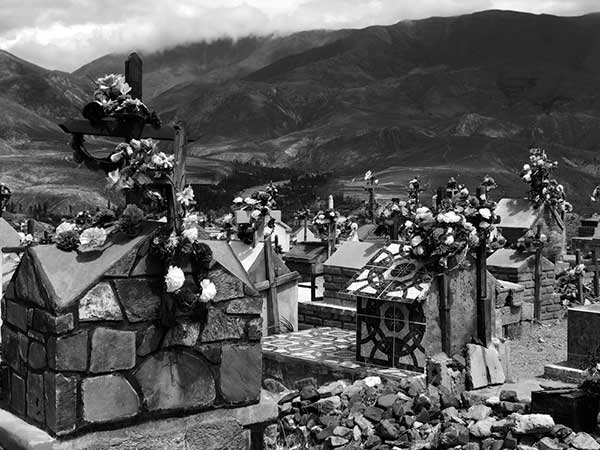
The cemeteries in the Quebrada de Humahuaca are spaces of recognition for their community, because they combine the present with the past, evidencing the construction of place. In them, the landscape can be perceived through its high symbolic content, where it also materializes a human need of representation. The objective of this work is to analyze human practices as variables of spatial constructions and their landscape-territorial impact on the cemetery of Huacalera. We work with the observational method and we made field work during celebrations. The work is developed from conceptualizations of territory, landscape and place. We later delve into the reading of the mentioned case as spatial type and in the understanding of their landscape-territorial impacts as assets at the time of construction of place. In addition, are also exposed the cultural and perceptual variables considered in the cemeteries of the mentioned region, in their spatial logics.
Downloads
References
Aliata, F. y Silvestri, G. (1994). El paisaje en el arte y en las ciencias humanas. Buenos Aires, Argentina: Centro Editor en América Latina.
Avenburg, K. y Martínez, B. (2014). Experiencias e interpretaciones en performances rituales. (Iruya y El Cajón, noroeste argentino). Cuadernos de Antropología Social, 39, pp. 115-147.
Boschi, L. y Nielsen, A. (2004). Quebrada de Humahuaca. Itinerario Cultural con 10.000 años de historia. San Salvador de Jujuy, Argentina: Gobierno de Jujuy.
Colón Llamas, L. (2005). Espacios para los muertos y ritos para la memoria. Las ciudades y los muertos: Cementerios de América Latina. Bogotá, Colombia: Instituto Distrital de Cultura y Turismo.
Consejo de Europa (2000). Convenio Europeo del Paisaje. Florencia, Italia.
Fernández, M., Asís, O. y Turturro, C (2017). Los cementerios, territorios de memoria urbana e identidad. En VI Jornadas de Investigación Encuentro y reflexión: investigación, enseñanza y transferencia: patrimonio intelectual. (pp. 273-282). Córdoba, Argentina: Facultad de Arquitectura, Urbanismo y Diseño de la Universidad Nacional de Córdoba.
Ferrari, M. y Paterlini, O. (2014). Aproximación al estudio del Paisaje Cultural de la Quebrada de Humahuaca. En XII Congreso Internacional de Rehabilitación del Patrimonio Arquitectónico y Edificado. Bauru: CICOP.
Garro, J. (2014). Paisajes culturales en pequeñas localidades: transformaciones territoriales de localidades del centro y noroeste argentino motivadas por eventos culturales masivos considerados "patrimonio intangible". En Seminario Internacional de Investigación en Urbanismo. VI Seminario Internacional de Investigación en Urbanismo. Barcelona, España.
López Hernández, E. (1993). Lugares Sagrados de los pueblos indígenas. En: Agenda Latinoamericana, ’94, pp. 110-111.
Martínez Montoya, J. (2004). La fiesta patronal como ritual performativo, iniciático e identitario. Zainak. Cuadernos de Antropología-Etnografía, 26, pp. 347-367.
Martínez Montoya, J. (1997). La montaña como espacio privilegiado de identificación socio-cultural. Zainak. Cuadernos de Antropología-Etnografía, 14, pp. 97-115.
Nogué, J. (ed.) (2008). El paisaje en la cultura contemporánea. Madrid, España: Biblioteca Nueva, S. L.
Nogué, J. (2010). El retorno del paisaje. Enrahonar: an international journal of theoretical and practical reason, 45.
Norberg-Schulz, C. (1980). Genius Loci. Towards a Phenomenology of Architecture. Estados Unidos: Editorial Rizzoli.
Pastor, G. (2008). La construcción del paisaje cultural en la ordenación del espacio turístico. El Valle de Tafí. (Tesis de Doctorado). Universidad de Sevilla, España.
Raffestin, C. (1981). Por una geografía del poder. México, México: Colegio de Michoacán.
Soja, E. (1985). The spatiality of social life: towards a transformative retheorization. En: D. Gregory y J. Urry, Social Relations and Spatial Structures. (pp. 90-127). London, UK: Macmillan.
Zusman, P. (2008). Perspectivas críticas del paisaje en la cultura contemporánea. La valoración cultural del paisaje. El paisaje en la cultura contemporánea. Madrid, España: Biblioteca Nueva, S. L.
Downloads
Published
Issue
Section
License
Copyright (c) 2022 Anales del Instituto de Arte Americano e Investigaciones Estéticas «Mario J. Buschiazzo»

This work is licensed under a Creative Commons Attribution-NonCommercial-ShareAlike 4.0 International License.