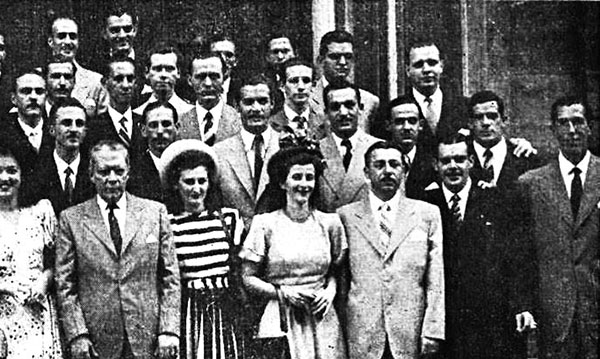
María Laura Osser
One flâneuse for Modern Architecture in Brazil
Keywords:
gender, modern movement, architectural journals, María Laura OsserAbstract
This article deals with the trajectory of Maria Laura Osser, a character living in Brazil, the result of intercontinental migrations of the mid-20th century and to whose name the historiography of Brazilian architecture owes a line. Methodologically, the results were obtained by combining previous academic works in which Osser appears -often- in secondary form, with periodic series published between the 1940s and 1970s. Those qualities of otherness of which she was the owner (woman, immigrant, exiled, professional), sensitizes her gaze to the architecture of Brazil at that time and compiles the reasons that made this analysis possible, understanding that her career must be understood as a flâneuse that transcended the role of mere spectator, stroller and observer, to become a producer of images of the metropoli that traveled in a country that was not her own, she knew how to understand as his own.
Downloads
References
Bullock, N. (2019). L’Architecture d’Aujourd’Hui, the André Bloc years. Modernism and the profesional architecture journal. (pp. 169-183). Nueva York, EUA: Routledge.
Cappello Camargo, M. B. (2017). Arquitetura moderna brasileira nas revistas especializadas estrangeiras anteriores à Brazil Builds (1931-1943). Rutas ibero-americanas. Contactos e intercambios en la arquitectura del siglo XX. (pp. 125-150). Madrid, España: Editorial Mairea Libros.
Dudeque Taborda, I. (2019). A contribuição das arquitetas nas primeiras décadas do IAB. Recuperado de https://iab.org.br/noticias/contribuicao-das-arquitetas-nas-primeiras-decadas-do-iab
Falbel, A. (2016). Arquitetos imigrantes no Brasil: uma questão historiográfica. En 6º Seminário Docomomo Brasil. Recuperado de https://docomomo.org.br/wp-content/uploads/2016/01/Anat-Falbel.pdf
Frisby, D. (2007). Paisajes urbanos de la modernidad. Exploraciones críticas. Buenos Aires, Argentina: Universidad Nacional de Quilmes/Prometeo.
Grosfoguel, R. (2016). A estrutura do conhecimento nas universidades ocidentalizadas: racismo/sexismo espistêmico e os quatro genocídios/epistemicídios do longo século XVI. Revista Sociedade e Estado, 31(1), pp. 25-49.
Lima, A. G. (2013). Arquitetas e arquiteturas na América Latina do século XX. São Paulo, Brasil: Altamira.
Monsiváis, C. (2000). Aires de familia. Cultura y sociedad en América Latina. Barcelona, España: Anagrama.
Navarro Swain, T. (2006). Os limites discursivos da história: imposição de sentidos. Labrys: Revista de Estudos Feministas, 9, pp. 1-20.
Sosa, E. (2009). La otredad: Una visión del pensamiento latinonamericano contemporáneo. Letras, 51(80), pp. 349-371.